https://www.timesfreepress.com/news/business/aroundregion/story/2016/may/21/us-xpress-truck-driver-compete-ironmchattanoo/366794/
Monday, August 13, 2018


Monday, May 23, 2016
Pictures of the Ironman
Click for a Facebook album.
https://www.facebook.com/media/set/?set=a.10209915563985287.1073741837.1219753002&type=1&l=47e86b6833
https://www.facebook.com/media/set/?set=a.10209915563985287.1073741837.1219753002&type=1&l=47e86b6833
Friday, May 13, 2016
Who I Am, and Why it Matters
Every athlete toes the start
line with a story. All of them are unique, each of them are inspirational to
others, in some way.
I am a truck driver. I belong to a
profession that is not known for the fitness of the people who stay
in the industry for a long time. Wait, let me amend that. Truck
drivers have a reputation for their fitness level, but it is not a
good reputation. The consensus view, even among other drivers, is that truck drivers tend to be grossly overweight, smokers, sleep
deprived, with more of a penchant for barbecue than a brisk walk
around the truckstop.
The image is not unwarranted.
According to a study performed by the National Institute of
Occupational Safety and Health in 2014, long-haul truck drivers are
more than twice as likely to be obese as the general population (69%
vs. 31%). We are also more than twice as likely to be morbidly obese
(17% vs. 7%), and to smoke (51% vs. 19%). We are twice as likely to
have diabetes (14% vs. 7%). All of this is taking place in an
environment where federal regulations are growing stricter on just
how out-of-shape someone can be, and still safely operate a
commercial motor vehicle. Sometimes, though, it takes more of a wake
up call than than the government telling you that you are unhealthy.
As
a third-generation trucker, I was not surprised that when I first
went into driving, I began to put on some weight. Driving is a
demanding profession, and at the end of a long, stressful day I only
wanted to grab a bite to eat and hit the sleeper berth. When I met my
wife in 1989, and we started driving team, the challenges only
increased. Driving around 22 hours a day, we did not have the time,
nor the energy, to exercise and learn to eat right. My weight went up
way past the point that I did not like what I saw in the shower-room mirror. I hit a point where my energy was low, my
back hurt all the time, and I would get winded just by climbing up a
few stairs. We decided to make some changes after a trip to Alaska in
1992.
A
short hike will allow visitors to Exit Glacier, on Alaska's Kenai
Peninsula, to climb up to the ice fields. The hike is considered
moderate in difficulty. We wanted to see the ice fields, but knew
that “moderate” may have been beyond our limits. We had always
planned to get back in shape “someday.” For the first time, a
possible adventure had come up, and we were not fit enough to enjoy
it. Out of our frustration, we decided to set a goal. We wrote our
goal on a piece of paper and posted it where we would see it
everyday. We wanted "To be ready for whatever may be in store
for us!" We began a journey that involved learning about
nutrition and exercise. The small changes we made became bigger
changes and then bigger goals. About thirteen years later, I set a
huge goal. I wanted to train for, and run, a marathon.
Most
marathon training programs call for building up weekly miles of
running. I changed my priorities to suit my goal. If the truck was
stopped, I was running. My weekly miles progressed up to twenty miles
per week, then thirty, then even a forty-mile week. Although most runners would
consider me woefully under-trained, I completed the Rock-N-Roll
Marathon in Phoenix in January of 2006. Running turned out to be a
great way for me to exercise on the truck. It was efficient, I could
get my heart rate up quicker than seeing blue lights in my rear-view mirror. Running provided a great break from
driving. Only minimal gear was required, so not much space in the
truck was taken up with exercise equipment. Now I have completed
five marathons, two half-marathons, a number of 5Ks, two sprint
triathlons, an Olympic-Length triathlon, and I am about to try my
longest race ever, a Half-Ironman. 70.3 miles of swimming, cycling,
and running. Cindy and I still like to eat barbecue, but we make
daily decisions to be active and watch what we eat.
I
do hope my story is inspirational. Currently,
it seems that if we drivers see a fit person driving a truck, we
think he is new to the industry. We see a heavy person driving a
truck, and we think they are a veteran driver. If we see a
four-hundred pound person anywhere, we think that they must drive a
truck for a living. I have a dream that we can change that line
of thinking.
I would like
to see a scrawny person driving a truck thought of as a brand-new
driver. A heavy person driving a truck will be thought of as a
newbie, one who has not quite gotten it together yet. When you
will see a fit person getting out of their truck in running shorts,
you would think that he is a veteran driver who has figured out how
to live on the road.
Resources
exist, and are being created, for drivers who have decided to make a
change. We have to get the message out to them that they can make a
difference in their lives. If I can do it, they can do it. If getting the message out involves swimming, cycling, and running around the beautiful city of
Chattanooga for a day, I'm in.
 |
| A construction worker starts driving a truck, circa 1988. On my way to over 280 lbs. |
 |
| Finishing my first marathon, 2006. Back in 1-derland. |
 |
| Olympic-Length Tri finish. Over 90 lbs lighter. |
Saturday, May 7, 2016
Cycling on the Road
The cycling part of the Half-Ironman is 56 miles. The race in Chattanooga goes into the hills of Northern Georgia. Did I say hills? That's only because I am from Colorado. They are mountains. The iconic advertising on barn roofs throughout the area does not talk about the view from Lookout Knob. It is called Lookout Mountain. I think they say you can see all fifty states from the overlook, and you actually look down on the moon from the top. At least that's how it will feel on my 30-year-old Cannondale, that I bought for $400 on Craigslist.


Cindy and I have kept a bike on the truck for years. We have a tandem, and a folding Dahon bike.


Running or cycling around the truckstop can be dangerous, smelly, and irritates other drivers. Then again, maybe they need a little "encouragement".

I had to get in some workouts on the bike, though. A pleasant ride with Cindy to Old Town Sacramento for dinner is different than racing youngsters with $6000 tri-bikes.
So I did.
 |
| 32 miles in Sacramento CA |
 |
| 51 miles in Fontana CA |
 |
| 56 miles around Kent WA |
 |
| 65 miles around Denver CO |
Am I ready? I have certainly tamed the mental beast a bit. I know I can ride that far. Now, as for running a half-marathon after...
 |
| Bugs are protein. Protein is good, right? |
Friday, May 6, 2016
Looking More like a Tri-bike.
Aero bars? Who needs that nonsense? I used to think that. Then I fought a fifteen mile-per-hour headwind one day on the way back to my house from a swim workout. I was a little tired, but I felt like I was riding straight up a steep hill. Whew!
 |
| 45 bucks on Amazon for these clip-on Aero bars. I spare no expense! |
 |
| We did a bit of adjusting to get the fit right. |
Tuesday, April 26, 2016
Trail Running
Why incorporate trail running into a program where the race is not on a trail? Because I like running on trails. So much of staying fit while driving a truck has to do with the mental battle. Driving is stressful, shippers and receivers often take more of your "workout" time than they should. The days are long, and weather can keep you from getting out of the truck, if you let it. Anything that will help you look forward to moving is beneficial. Heck, walk to the donut shop, if that's what it takes, but move. I can actually talk myself into wanting to get out and run, if I can find something, anything, that appeals to me. Trails are great for looking at plants, wildlife, scenery, and they are car-and-truck free!
 |
| Desert running with my sweetheart near Chiriaco Summit CA |
 |
| Ocotillo are fascinating. Many of them were blooming this rainy day. |
 |
| Cindy likes the downhill part.
Serious trail running means dodging mountain bikers on single-track trails through the woods.
|
 |
| The Shawnee Mission Trail System, near Kansas City. |
 |
| Ahhhhh... |

 |
| Good thing there was a four-inch tall photographer in the woods. |
Sunday, April 17, 2016
Swim Workouts on the Road
Driving through Florida, I often look at the inviting lakes and streams, dream of going for a swim, and then wonder how you can tell if there are any alligators in a particular lake. I assume that the people who live there know where to swim, and where not to swim, but to us travelers, it can be a mystery. A mystery you don't want to solve by getting nibbled on by a ten-foot long prehistoric critter.
The swim part of the Half-Ironman is 1.2 miles in open water. In a 50-yard lap pool, that is about 42 laps. The first time we got home I swam 1.6 miles in about 70 minutes in our local recreation center. I also got in a mile at a YMCA that is across the street from a truckstop in Weatherford, Oklahoma. I wanted to get in some kind of open water swim, and kept looking on Google, and Google Maps for places to go. We have observed some swimming areas near truckstops over the years. There is the Columbia River, near Troutdale, Oregon. Also the lake near the TA in Sparks,Nevada. The state campground is right across I-15 from the Flying J in Willard, Utah. This early in the year many of the swimming areas are not open yet, because it is too cold to swim.
We had a day off, waiting for a load, in Sacramento, California. Cindy agreed to run with me down to the Sacramento River, wait while I swam, and run back with me to the 49r Travel Plaza where we were parked. I found a website that had river temperature information on one of their links. The river was 58 degrees. Sounded chilly. The Chattanooga River is supposed to be 72 degrees during my race. Sounds nicer. As it turns out, 58 degrees is CRAZY chilly. Not bad for wading, but I was glad Cindy was there to encourage me to get in.
I look like I am checking my equipment in this picture, but I am actually working up my nerve to get in the water. BRRRRR!

Dang, when we get by home next time, I am grabbing my wetsuit! I will also be praying for loads to Florida. Maybe those gators aren't such a big deal after all.
Friday, March 25, 2016
Facebook Alert: It's Official...

Most of the comments were encouraging, with some misgivings for my safety. About what one would hope for from a group of friends and Facebook friends.
Monday, March 7, 2016
You Want Me to What?
On March 7th, 2016, I received an exciting (and frightening) email from Human Resources at our employer, US Xpress.


Anxiously, I clicked on the link. I was thinking that a challenging race late this summer would set me up for a nice PR on my December marathon in California.
May 22, 2016
May? As in May: not next month, but the one after that? I double-checked. Yep, May of this year. Conflicting thoughts raced through my head.
Don't people train for months for Half-Ironman races? Free! As in, "no entry fee?" Don't those things cost $300 or so? Didn't I just have the lowest mileage months of running in years in January and February? Yea, but free! And no time-off counted against you. Let's see, last bike ride was October of 2015, and last swim workout was in Costa Rica in September of 2015. Hey, last time US Xpress offered you free entry into a race, it was an Olympic Length Triathlon occurring just a week after a marathon. You pulled that one off. But a Half-Ironman is more than TWICE the distance of the Olympic-length triathlon.
I came to the conclusion that I would have to be an idiot to sign up for such a challenging race with so little preparation time.
So. Of course I signed up.
See you in Chattanooga.
Saturday, August 1, 2015
Still Hollow Trail Half-Marathon
Race Report August 2015
I had never run a half-marathon before. My splits on some of my marathons have been under two hours, so I thought I might do a half under 2:00:00.
Facebook friends are often talking about noticing a race in an area, and just signing up for it. In the spirit of camaraderie, I began surfing the internet. I knew I had a day off in lovely Chattanooga. Cindy and I were to be recognized for driving two million safe miles on Saturday, so Sunday was free. As it turned out, the meeting was great, a group of us toured the corporate headquarters, and met a bunch of people that previously were only voices on a telephone line. I found a few races, including a trail race in a wildlife area just across the interstate from US Xpress.
One of the guys in Customer Service is a runner, and I talked him into going to the race also. Adam opted for the 10K, instead of the Half. He let me know that racing on trails was likely to cost me about one to two minutes per mile compared to my road-racing times. He was right. I finished in 2:14:57.
Adam met me in the dark morning of the race at the sign-up desk. You don't know until you try it, but it is hard to recognize people in the dark woods, wearing headlamps. As the sun came up, we were on our way. For the first 10K, much of the race was on a wider trail. Adam is a talented runner, and we did not stay together very long. I saw him crest a hill, turn right between two trees, and have never seen him since. (Don't worry, he is not missing. I spoke to him on the phone, and no one else took over his job.)
I had never run a half-marathon before. My splits on some of my marathons have been under two hours, so I thought I might do a half under 2:00:00.
Facebook friends are often talking about noticing a race in an area, and just signing up for it. In the spirit of camaraderie, I began surfing the internet. I knew I had a day off in lovely Chattanooga. Cindy and I were to be recognized for driving two million safe miles on Saturday, so Sunday was free. As it turned out, the meeting was great, a group of us toured the corporate headquarters, and met a bunch of people that previously were only voices on a telephone line. I found a few races, including a trail race in a wildlife area just across the interstate from US Xpress.
One of the guys in Customer Service is a runner, and I talked him into going to the race also. Adam opted for the 10K, instead of the Half. He let me know that racing on trails was likely to cost me about one to two minutes per mile compared to my road-racing times. He was right. I finished in 2:14:57.
 |
| Finish line smile? Or finish line grimace? |
Adam met me in the dark morning of the race at the sign-up desk. You don't know until you try it, but it is hard to recognize people in the dark woods, wearing headlamps. As the sun came up, we were on our way. For the first 10K, much of the race was on a wider trail. Adam is a talented runner, and we did not stay together very long. I saw him crest a hill, turn right between two trees, and have never seen him since. (Don't worry, he is not missing. I spoke to him on the phone, and no one else took over his job.)
After the 10K mark, we went onto a single track trail. At first, I had most people passing me. "On your left." is the magical words to pass someone. I was glad I learned it early. I maintained my same pace, got into a great rhythm, and started putting up negative splits. I was a little worried that I might have been pushing it too hard, especially when I started passing many of the people who had passed me earlier. "On your left." "On your left." I kept saying. One guy told me his legs were "crazy heavy." I expressed my concern that I was going out too fast. He said I looked great, and we were on our way in, not out.
About mile eight, I had the thought that I had not stumbled on the root-and-rock infested trail. About 300 feet later... Yeah. Not even a fall though, I caught myself on the way down and kept striding. Another mile or so and I had the thought, "Wow, only one stumble, and I did not hit the ground!" About 600 feet later... Again, yeah. A granite outcropping gave me a nice scrape on my shoulder, forearm, and knee as I did a parachute landing fall to avoid twisting my ankle. A guy at the finish line later said "Welcome to trail running." I responded, "No blood, no glory." He seemed to like the exchange. So did I.
I had never fallen during a marathon road race. But then again, I had never seen deer on the course, nor felt the Zen of letting my feet find the next spot to land on their own, nor come away with such a big smile on my face. It was a great day.
Monday, April 6, 2015
Monday, December 9, 2013
How NOT to Run a Marathon
I did not plan ahead to do everything wrong when I met some friends to compete in the Flying Pig Race Series. Things just worked out that way. I thought it might make a great tutorial.
First, under-train.


Run another race the day before your marathon.

Have a few beers the night before the race.


Leave your gear in the hotel room
Start off too fast.
Do not change your race plan to meet your training.


Set absurd, unrealistic goals.


How to Run a Marathon Poorly
My race plan for the year was to run a triathlon with my brother-in-law in August, then run the Denver Rock-N-Roll Marathon in October. I was running, but not really training through the winter. Then I decided to run with some friends in Cincinnati in May. Slight time adjustment.
Cindy and I have been active on a Facebook group called Truckin' Runners. Most of the posts are about places to park a truck and go for a run. Topics also include running equipment, shoes, cross-training, and some tucking industry stuff. We also encourage each-other, or offer consolation, about our workouts and race plans. The group consists of everyone from people who just walked the first mile in years to runners who race Ultra-Marathons, or races longer than the 26.2 miles of a marathon. The group is very supportive. We are an unusual niche, drivers who want to make an effort to stay fit while trucking. We connect very well with each other, and are often looking for a chance to do a workout together somewhere on the road.


The Truckin' Runners had been trying to get a group together for a race for some time. The 2013 Flying Pig Race Series was the biggest turnout yet, with six members racing. The race offered a 5K, a 10K, a 10K Pump-N-Run where you bench press a weight determined by your weight and age, then run, and a marathon. I decided to run the marathon. Cindy decided to run the 5K.
I had a shorter time to train then I would have liked, but it could have been enough. I missed some runs because I was helping Cindy with her training, but I still could have had plenty of workouts. I drive a truck for a living, and do not have a regular schedule, but I have trained for other marathons successfully in the past. The three together got me this time, though. I ran far fewer total miles then past marathon training, and did not get in the critical long runs I needed.
Cindy had used the Couch-to-5K program to work her way through the steps needed to race a 5K. I had gone on almost all of the workouts with her, and was proud of her improvements. She had run/walked a couple of 5K races before, but this was the first one where she had really put an effort into the training. I thought she could break forty minutes, but she was concerned that her time might be very slow. As the date of the races came about, I knew I was not going to have a great marathon, so I signed up to run with her. It just seemed right, after all the training we had done together. Cindy ran 39:42. I will always treasure the memory of running that race with her, and would not trade it for anything. Even a great marathon.

What the heck, the other runners were celebrating great times in the 5K and 10K, why not tip a few with them? Well, other than dehydration, lower energy levels, and an increased inflammation response. The micro-brewery had some tasty beer, though. It was nice to visit with friends.


OK, I always ran with my Garmin 205, and it did not make it to the race with me. I like to watch my pace, and needed to keep on track with my Garmin if I was going to keep from doing something stupid like starting off too fast.
John Weibe was the other Truckin' Runner who had signed up for the marathon. We met up in the starting corral before the race. My goal for 2013 was to run a nine-minute-per-mile marathon. That would work out to 3:55:48 total time. John had run marathons faster than that before, and was expecting to be under four hours, but not a lot under four hours. We decided to run together, at least for a while.
I had never raced with someone before. Maybe having some companionship would help me meet my goal, even though I was not really prepared. I started looking for the pacer with the banner that read 4:00. John looked for the pacer with 3:40. Eeeks. What the heck, I came to spend time with my friends. Maybe I could see how much good having a running partner could be. Maybe I could coast to a 3:40 and qualify for Boston. Maybe I'm and idiot and I would pay for my mistakes.
The band at the start line stopped playing. I wonder what their manager told them about the gig. Be there at 4:00 in the morning, dress warm, and act excited. The announcer gave proper homage to the sponsors, and we had a moment of silence in memory of the victims of the bombing at the Boston Marathon earlier in the year. Then we were off. I love the start of a race. The sun was just turning the sky pink as we ran over the bridge into Kentucky.

John and I were talking, and maintaining a pace between 8:30 and 8:45 minutes per mile. After we got warmed up and the running smoothed out we crossed over the bridge back to Ohio. I noticed that my respiration did not fully recover from the "hill" the bridge created. We crossed the 5K mark. I asked John how he felt. He said he felt like he was "taking a walk in the park." I felt pretty good, but this was my fourth marathon, and I knew my breath was too short and my heart was too fast for only being at four miles. I told John I was going to slow to a 9:00 per mile pace, and I would see him at the finish line.

The huge hill starts about mile six. I watched the pace teams go by me, and tried to stay with the 4:00 team. They had gotten a bit ahead of me, but I caught them on the last half-mile of the hill. As we crested the hill, they took off, and as they rounded a corner, I knew I had seen the last of them. That was near mile eleven. If I had listened to my own common sense, I would have switched to the Half-Marathon in the week before the race. I still could have ran with John, because the races started at the same time. The runners of the half split off from the runners of the full during the race. If I knew I only had a couple more miles to go, I may have been able to finish the half strong, probably around 2:00. As it was, I went into survival mode. I had fifteen more miles to run, not two.
Setting mid-run goals is something I do in my training. I like to tell myself that if I run hard to the next phone-pole, I can slow up for a while. Or that if I keep my pace for a certain amount of time, I can take a drink out of my water bottle. I have found that I need to take my reward, or my body figures out that I am trying to trick it and the goal-setting does not work.
I told myself that if I made it to mile sixteen with no walk-breaks, I could take my shirt off to stay cooler. I had been walking through the aid stations, but I meant a real walk break, like 2/10 of a mile. Or a nap. Next thing I knew I was walking up to the aid stations, and a bit after. Those stations where they hand out water and sports drink got to be a quarter-mile long. I could not make my goal, but I still took my shirt off.
I set several goals I did not complete, and it was a bit discouraging, but I did set one that did me some good. I decided to have fun. I called Cindy at mile fifteen to tell her I was going past a Kroger Grocery store. I asked her if she needed me to pick something up, maybe a gallon of milk or a case of soda. The runners around me looked at me either in horror or with a smile. At mile seventeen, there were some national guardsmen on a hill with what looked like AK-15s. It was a somber reminder that after the Boston terror attack this sight may become a part of marathons. I hollered at one of the guardsmen. "SHOOT ME!" They looked surprised, then laughed. "C,mon," I said. "Really land one, too. If you wing a runner they will just keep going." I got a few chuckles from the other runners, but no one offered to knock me out and end my pain.
Keep running.
Of course, I could have stopped at any time and had my first DNF (did not finish). By the time I met my cheering section at about mile twenty, I was really hurting. My legs were cramping, my back was going into spasms, I had gotten light-headed a few times. They had seen John go by some time ago, and he still looked strong. I did not. He ended up finishing in 3:53:40, and was happy with the time on such a hilly course. Jon Narron, who had crushed his goal of breaking an hour in the 10K the day before, ran with me a bit as a way to cheer me on.

The last three miles were brutal. I had left my shirt with Cindy back at mile twenty. Now a cold rain had begun. I no longer had the energy to enjoy all the fun pig-related signs. I was down to half-walk/half-run regiment. I set a final goal to run the last mile. I got tunnel vision, and every step my legs said STOP STOP STOP. I literally could not bear the thought of running 24 miles of a marathon and quiting, so I kept moving. Step by step I plodded on, hoping the last mile was all downhill. People kept lying to me from the sidelines "You are looking great, Daniel!" "You've got this, man!" Or the worst lie, "This is the easy part."
I went into a sort of shambling step that could be called a run at 25.2, and found that the last mile was not downhill. I did not know that a mile could be so long. I pressed on, and even picked up the pace as I entered the crowds cheering at the last few hundred yards. My wife was in the crowds somewhere, but I did not see her. I crossed the finish line. I always remember the finish line. This one hurt, but I did cross it. My time was 4:53:49, but I crossed the finish line.

The other Truckin' Runners fared better than I did. Cathy Cogswell beat her goal in the 10K, and Pete Mycek maxed out the bench press at the Pump-N-Run with 20 reps that lowered his 10K time of 45:56 to where we won his division, and medalled as the third male overall.

I like that it makes perfect sense.
I had prepared less for this marathon than any other, and I had ran my slowest time. I am encouraged that if I prepare enough, I can break 4:00 in 2014.
Monday, December 3, 2012
Race Report REV3 Triathlon
REV3 Triathlon
Anderson SC, October
2012
Two reefers, a van, a tanker, and three
bobtails were parked in the corner of a busy parking lot that was not
really designed for truck parking. Your local Walmart? A NASCAR
race? Would you believe it was the parking area for the racers at
the REV3 Triathlon in Anderson SC?
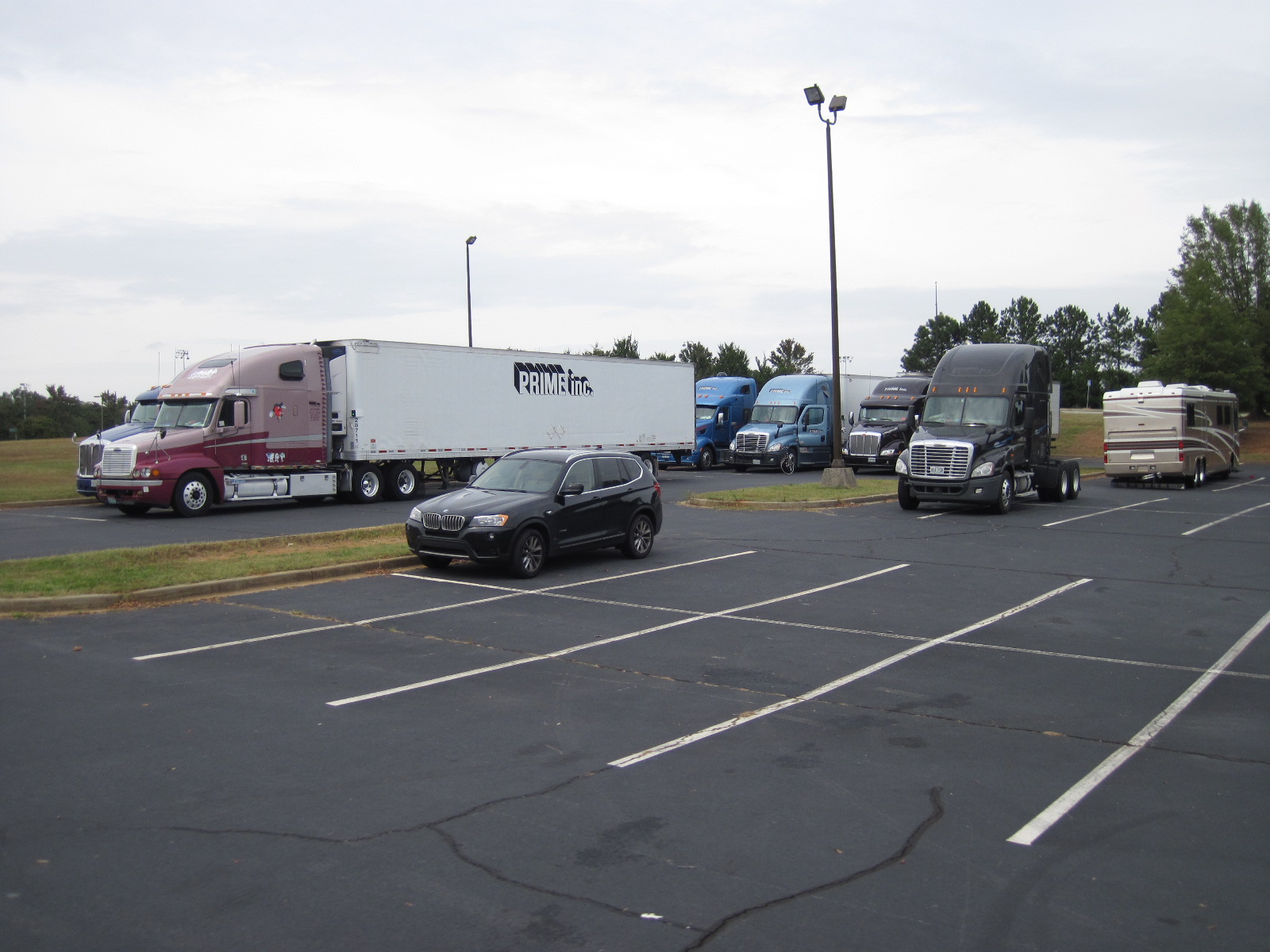
The first annual triathlon started in
1978 in Hawaii. The race incorporated three events, a 2.4 mile swim,
a 112 mile bike race, and a run of 26.2 miles. Since then, the
popularity of the sport, with varying distances, has grown every
year, and was included in the Olympics in 2000. Perhaps many
recreational runners and cyclists looked at the race as a new
challenge to replace the 10K runs or century rides they completed in
the past. But truck drivers? Who would have anticipated truckers
competing in races that can strain the best of athletes?
Pilot/Flying J, in cooperation with US Xpress's Highway to Health
thought so. In summer of 2012 they posted on the U.S. Xpress
Drivers facebook page that drivers would have a chance to compete
in a triathlon in October.
I had tried out a couple of the
shorter, sprint-length, triathlons in the past couple of years and I
was excited that I could be in a longer event. Especially a longer event where Pilot/Flying J would pay my entry fee. I did have a few concerns,
though. I had very little chance to swim while driving over-the-road. I did not own one of the race-style road bikes used in triathlons. Most importantly, I was planning to run a marathon in the month of October.
Do not get the impression I am some kind of fitness fanatic that happens to drive a truck,
though. As a third-generation trucker, I was not surprised that when
I first went into driving, I began to put on some
weight. Driving is a demanding profession, and at the end of a long,
stressful day I only wanted to grab a bite to eat and hit the
sleeper berth. When I met my wife in 1989, and we started driving
team, the challenges only increased. Driving around 22 hours a day,
we did not have the time, nor the energy, to exercise and learn to
eat right. My weight went up way past the point that I did not like
what I saw looking back at me in the shower-room mirror. I hit a
point where my energy was low, my back hurt all the time, and I would
get winded just by climbing up a few stairs. We decided to make some
changes after a trip to Alaska in 1992.
A short hike will allow visitors to
Exit Glacier, on Alaska's Kenai Peninsula, to climb up to the ice fields. The hike is considered moderate in difficulty. We wanted to see the ice fields, but knew that “moderate” may have
been beyond our limits. We had always planned to get back in shape
“someday.” For the first time, a possible adventure had come up,
and we were not fit enough to enjoy it. Out of our frustration, we
decided to set a goal. We wrote our goal on a piece of paper and posted it where we would see it eveyday. We wanted "To be ready for whatever may be in
store for us!" We began a journey that involved learning about
nutrition and exercise. The small changes we made became bigger
changes and then bigger goals. About thirteen years later, I set a
huge goal. I wanted to train for, and run, a marathon.
Most marathon training programs call
for building up weekly miles of running. I changed my priorities to
suit my goal. If the truck was stopped, I was running. My weekly
miles progressed up to twenty miles per week, then thirty, then
forty. Although most runners would consider me woefully
under-trained, I completed the Rock-N-Roll Marathon in Phoenix in
January of 2006. Running turned out to be a great way for me to
exercise on the truck. It was efficient, I could get my heart rate
up quickly. Running provided a great break from driving. Only
minimal gear was required, so not much space in the truck was taken
up with exercise equipment. I ended up running another marathon in
2009, and was training for the third when I read about the REV3
triathlon.
We got a kick out of seeing the trucks
parked in the racer's area. We wondered if the other racers thought
that it took several semi-loads of equipment to put on a race. One of the trucks looked familiar. A
distinctive owner-operator's paint-job made it stand out. Cindy
remembered that we had met the driver at another race, the “Big Rig
5K” at the Great American Trucking Show in Dallas the year before.
We also saw the “fittest trucker” in the America, a triathlete
named Siphiwe Baleka, who now works for the health division of Prime
Transportation. We received a warm welcome from the
representatives of Pilot/Flying J. Dave Parmly asked me if I wanted
some “racing skins.” Sure. What the heck are racing skins?
It turns out they are a set of
clothes for racing triathlons.
I had
somehow I managed to get in a couple of swim workouts since summer.
I had also acquired a road bike on Craigslist. I had finished my
marathon without hurting myself. As we arrived at the race area I
was sore, unprepared, and with a bike I had only ridden two miles.
But I had a goal. I was going to finish an Olympic-length triathlon.

The first part of
the race is the swim part. The length is 1500 meters, a couple
hundred yards short of a mile. I swam in high school, and planned to
get out near the front of the group of racers I was starting with,
then I would not have too much traffic to deal with. We were to swim out from shore, around four large buoys, and back to shore. I must have
forgotten that I was not in high school anymore, that I had not raced much in the water in 30 years, and (oh yeah) I was a sprinter in high school, not a distance guy. By the end I was
thrilled to have just survived as I moved into the transition area to
start the 40k bike part. Cindy cheered me on as I washed down lake
water with some Gatorade got on my used bike and headed out to see
if we could survive for 25 miles in hilly South Carolina.
 I had paid $400 for
my bike. While shopping I had discovered that racing bikes cost
anywhere from $800 to $4000, and most used bikes were close to $1500. I
clicked pretty well with the cycling part of the race, and started
counting the total value of the bikes I passed. Me and my "vintage" Cannondale passed about $40,000 of fancier race and tri-bikes. About two miles from the end of the cycling part, I
finally had a mechanical challenge. The front chain came off the
gear. Reaching down, I thought I could get it back on while rolling
22 mph. After a few tries, I decided to stop and fix the chain
before I hurt someone. Especially me. Then when I stopped, I forgot
that I had on toe-clip pedals that keep your feet on the bike. I
just barely kept from crashing to the ground before finding out that
I could not lift my fatigued leg over the seat of the bike on the
first try. So much for dominating the cycle course. I looked more
like a Three Stooges routine. Chuckling at myself, I quickly got the
chain on and took off again.
I had paid $400 for
my bike. While shopping I had discovered that racing bikes cost
anywhere from $800 to $4000, and most used bikes were close to $1500. I
clicked pretty well with the cycling part of the race, and started
counting the total value of the bikes I passed. Me and my "vintage" Cannondale passed about $40,000 of fancier race and tri-bikes. About two miles from the end of the cycling part, I
finally had a mechanical challenge. The front chain came off the
gear. Reaching down, I thought I could get it back on while rolling
22 mph. After a few tries, I decided to stop and fix the chain
before I hurt someone. Especially me. Then when I stopped, I forgot
that I had on toe-clip pedals that keep your feet on the bike. I
just barely kept from crashing to the ground before finding out that
I could not lift my fatigued leg over the seat of the bike on the
first try. So much for dominating the cycle course. I looked more
like a Three Stooges routine. Chuckling at myself, I quickly got the
chain on and took off again.
Cindy was waiting for me at the second
transition area. She encouraged me while I dismounted the bike,
grabbed some more Gatorade, and took off onto the 10K (6.2 miles)
running course. Six miles did not sound that tough, after all the
marathon training. I started off pretty strong, but then walked
through a few of the aid stations and up one of the hills. During
the run, some of the racers who were doing the longer Half-length
triathlon caught up to me. They had started an hour before me, had
just swam, biked, and ran, about 65 miles, and were blowing my doors
off. I may have walked more, but a couple of them encouraged me to
keep it up. As I rounded the corner and saw the finish line, I
regained some energy from somewhere and finished the run a bit faster
than I had started.
 |
| Swim 43:52, T1 5:27, Bike 1:27:39, T2 1:19, Run 1:02:39 Finish 3:20:56 |

I had
reached my goal. I finished two races in the month of October. I am
always excited to see the programs rolled out by Mary Augustino,
Wellness Coordinator with US Xpress, that teach us to set goals and
learn to eat right. I have come a long way from being seventy pounds
heavier, addicted to tobbaco, and unable to run a single mile. It
all goes back to setting small goals, learning consistency, then
setting new goals. My wife and I are glad to be working for a
company that continues
in a leadership role as an advocate for driver health. The Highway
to Health
brings to drivers an awareness that they can take their fitness goals
beyond just losing a few pounds. Maybe I will even get a chance to
try that hike up Exit Glacier someday.
Sunday, October 14, 2012
St George Marathon 2012
St George Marathon 2012
7400
runners. Each running their own race.
In
January of 2006 I ran across the finish line of a marathon for the
first time. The moment the clock passed over my head with the
crowd's cheering in my ears was a moment I could hold onto the rest
of my life.
To
have set a difficult goal, planned for the goal, overcome
the challenges of preparation, trained the body,
trained the mind, and to have accomplished the goal; the entire
process changes you. You cannot go back to thinking that "good
enough" is "good enough."
You
know better, now.
You
have reached down inside, looking for something to get you through,
something to push back the voices of doubt and discouragement. You
found it. Just like you found it running 22 miles across that
dry lake bed in Arizona when the temperature topped 95 degrees. Like
you found it when a pickup doused you with a slurry of slush and snow
while you were running on a slippery road shoulder in Ohio. Like
you found it on countless mornings when you did not want to lace up
your running shoes and get out, but you did.
That
"something" does not disappear at the finish line. When
life gets tough, you have what it takes to get tough back.
As I
rode my bike from the hotel in St George to the line of buses that
would shuttle the runners to the starting line 26.2 miles up Utah
Highway 18, I could feel that my third marathon finish line would
mean as much to me as the first two.
Many
of the people waiting to board a bus in the pre-dawn darkness would
see their first finish line today. Some of them have had many. At
least two had crossed a marathon finish over fifty times.
I sat
down in the bus next to a runner that gave me a companionable smile,
then pulled his hoodie over his head.
Message
received. “I am friendly, but want to focus and not chat for the
next 45 minutes.” Suited me, I would rather soak up the general
feel of how people prepared to run 26.2 miles as fast as they can.
Some
people talked about strategy for the course, about other races, about
victories and missed opportunities. Others stared into the darkness
at the road we were about to test ourselves on. A few people even
slept.
The
Course for the St George marathon has a net loss of almost 2500 feet.
In October this creates a challenge in the temperature difference at
the starting line, about 42 degrees today, and the finish line,
predicted to be 82 degrees.
At the beginning of the race a runner
can find thermo-blankets, hot chocolate, and bonfires. At the finish
a runner will find misters spraying cool water, Gatorade, and free
ice cream.
I was
on the first bus. As we pulled into the unloading area the
volunteers jumped to their duty stations, providing blankets,
lighting fires, playing music, and handing out beverages and fruit.
I
answered the call of nature first, then warmed myself by the fire
while I arranged my stuff into groups. First was the stuff I would
run with: clothes to toss during the first six miles of the race, my
phone and headset for taking pictures and listening to music, my
assorted energy shots of GU and Cliff and Nutrilite, and my Garmin
205 sports watch. The next pile was to be loaded into a truck and
would meet me at the finish line. I would put in my sweatshirt, ear
muffs, the light for my bicycle, and a magazine I brought but never
got around to reading.
More
buses were arriving, I drank some coffee and watched as people met up
with friends, danced to the music, stretched, and tried to keep warm.
I answered the call of nature again, this time waiting in line to do
so.
The
announcer had kept the dialog light, mentioning some of the stats of
the race and the diversity of the group of runners. He sounded
boisterous when giving accolades to the sponsors. Then he sounded a
bit serious as he mentioned that the start would take place in
fifteen minutes.
I
stayed by the fire. My time would not start until I crossed the
start line with the RFI chip in my bib. As the crowd went by I eased
into the line of runners as the pace team with a sign that said
4:00:00 went by. Breaking the four-hour mark was one of my goals
today.
About
forty feet from the start line, nature decided to stop calling me,
and started demanding my attention. I walked a bit further, thinking
it may just be a nervous twitch. No, it was not. I got out of line
and dashed for the porta-potties.
The
voice of discouragement gave me a shot across the bow.
“Stuff
is going wrong already,” it said. “Who could blame you if the
race went poorly?” I almost chuckled. That was lame. I was
thrilled this had happened before I crossed the line and started my
time. When I got out, the 5:30:00 pacer had just gone by. I got in
line.
“Who
is running their first marathon today?” She shouted.
A
chorus of cheers rose up. “Me too!” She responded.
“Just
kidding,” She reassured us amid the laughter of the crowd.
The
starting line was two rows of colorful rubber mats that crossed the
road. The readers for the RFI chips are protected underneath.
I
deliberately took all the regrets about not having enough time to
train, about the long runs I missed, about how unprepared I was, and
left them behind as I crossed the starting line. I thanked God for
new beginnings and began my race.
The
first seven miles were moderately downhill. The sun was not up, but
the sky gave just enough light to see the other runners. I was
passing a lot of people while running at a pace of 9:00 minute per
mile, but others were running faster than me.
Moving
through traffic while running reminds me of moving through traffic
while driving a truck. Looking ahead for openings, maintaining
situational awareness, being courteous. I glanced toward my “blind
spot” as I headed toward a narrow opening in the middle of a line
of slower runners. The gray-haired gentleman gaining on me nodded
for me to go first.
“Thanks,”
I said. “You go. I can barely hear your feet hit the ground.
I'll bet you're way faster than me.”
“Thank
you,” He said. “That's what I have been shooting for.” Then
he scooted through and disappeared from sight. I assumed he meant he
had been shooting for the soft foot-falls, not kicking my butt, but
who knows?
I
tossed my gloves alongside the road at mile three, and my outer shirt
at mile four. I might be able to claim them later, but they would go
to charity if not.
On
the way to Veyo hill, at mile seven, I had passed the 5:00:00 pacer
and the 4:45 pacer. I was determined to make a solid effort at the
uphills between mile seven and mile twelve. No walking, keeping a
good pace.
Just
before the hills started, we ran through Veyo, Utah. The whole town
seemed to have gotten up early to cheer the runners on. Everyone was
smiling as they ran, slapping high-fives and waving back at the
crowd.
Less
than a mile later, as the grade went to seven percent, I started to
see the detrimental effect that pushing yourself can have on runners.
People were trying to stretch out cramps, people were walking with a
limp, people were already throwing up. However, I also saw friends
encouraging each-other, I saw people get determined and press on.
I
felt great. I had trained on hills every chance I got the last
twenty weeks, and my pace was right on target. I had learned that
the best course planning on the St George Marathon
was to shoot for a negative split on the halves. In other words, I
could plan on running the second half of the race faster than the
first half. Many people run the second half fifteen minutes faster
than the first to break the four-hour mark. My pace was on target
for breaking 04:00:00 as I reached the half mark at 02:07:22.
According to theory, that is.
I had run my last marathon
in Seattle, and had hit the half mark at 01:59:50. The course in
Seattle was flat and fast in the first half. I had finished with a
time of 04:17:34 in Seattle, and was a little uncomfortable about
being behind that pace in St George. I felt like I had a lot left in
the tank at the half mark, and even at mile 17, where we topped the
last of the uphill grades. My only concern at that point was some
calf pain on a downhill about mile 15.
When we hit the first of
the long downhills, I was still soaking in the experience of the
race. My focus was there, but I was enjoying the comradeship of the
runners, getting blown away by the high desert scenery, and reading
tee-shirts. The “I am running from...” series seems to have been
popular at the expo the day before the race. I saw “I am running
from my family,” “I am running from my past,” “I am running
from YOU,” and even “I am running from the cops.”
I bumped my speed down below 8:00 per mile pace and held it for a while. Then I got a deep twinge in my right calf that threatened to turn into a cramp.
I bumped my speed down below 8:00 per mile pace and held it for a while. Then I got a deep twinge in my right calf that threatened to turn into a cramp.
I thought about my stride.
Lean toward the hill. Mid-foot strike. Shorter steps than on the
flat. Arms back a little. Everything seemed to be in order. I always
run through cramps. They usually get even with me later while I am
driving or sleeping, but they slowly go away if I keep moving. I
have no idea if that is recommended, or even wise, but it has worked
for me.
My right calf was feeling
better when my left calf started cramping hard. I tried slowing to an 8:15 pace and the pain eased a bit. I tried 8:30 and had even better
results. The hill leveled off and the pain went away. As I climbed
the hill at mile 17, everything was back to normal.
I had some concern, though.
I needed several 8:15 to 8:30 miles to make up for the slower
first half.
During training I had
encountered some calf pain on downhill grades. The internet told me
I was experiencing a form of eccentric muscle usage by “catching”
myself as I moved downhill. Although pain and DOMS, delayed onset
muscle soreness, could result, training on hills would solve the
problem. I trained as much as I could on hills, but when you work in
a vehicle that is moving 20 to 22 hours a day, your training time
could be anywhere. I had sought out hills, but could not always find
them, especially on a day that my training schedule called for fast
miles.
I reminded myself that I
had left training regrets at the starting line. I would do what I
could do.
At the next descent I could
feel the twitching kicking in after a few hundred yards. I slowed to
where I could continue. I felt like I was taking mincing steps, and
certainly not using the stride I had spent hundreds of miles working
on.
A banner told me I had
reached mile 21. I did the math, and realized a sub-four hour
marathon was not going to happen today. The voices of discouragement
and doubt gleefully began their barrage. If anyone told me that
distance running is not a mental sport, I would assume they had never
tried running at all.
All around me were people
who had started out too fast. Some were being attended to by medical
aids. Many were walking.
“Nice day for a walk,”
said the voice in my head. “You could still finish, but it would be
easier.”
I will never have this
day back. I'm going to keep running. I
shot back.
“That
sun is intense at this altitude, maybe walk in the shade and you
could go faster in town. You want to run fast when Cindy sees you,
right?”
I
want Cindy to know I do not give up when the going gets tough. I
growled mentally. I could feel the negativity affecting my energy
level, though.
A
gal running next to me moved into a walking pace with such a sigh of
relief that it almost brought tears to my eyes. NO! That
relief is for the finish line, DANIEL!
“You
really wanted that four-hour marathon, didn't you? Maybe next
time...”
Lord,
please give me something. I want to finish well. A
clear, strong, thought occurred to me.
I have
never raced without getting a personal record.
I
thought about that. Could it be true? My first 5K was in 2001.
Let's see, I've had four of them. And yes, each was a PR! Two
marathons, and the second was faster. Two sprint triathlons, and the
second was faster. Amazingly enough, I had always raced to a PR!
“Something
like that can't last forever,” the voice tried, but it was too
late. My energy and my focus were back.
Thank
you, Lord! I did the math. To
set a personal record, I could not walk at all. I needed to maintain
a 9:00 per mile pace. Some faster miles would give me a buffer zone.
I came
into town running a race against myself. I knew the crowds were
there. On a different day I could have enjoyed them. A couple of
bands were playing music. I kept my eyes forward. I hurt, but I
would not let myself think about it. Every muscle ached. The sun
beat down. Dizziness came and went as I willed it away.
A runner
went down hard ahead of me, and people came out to help him. He had
a runner's build and looked in way better shape than me. I looked
away and stopped thinking about him.
I
allowed myself to greet Cindy. She held up a sign she had made for
me the day before. She even ran a few steps with me, encouraging me
on. Later she told me I looked focused, but fast.
I
took the outside of every turn. I was not racing these people. I
wanted to see the road
ahead of me. One foot in front of the other. Later, on the race's
website, I found that in the last 7.5 miles I had passed 353
finishers, and only 11 had passed me. I never would have guessed
those numbers, I only knew the road and the sound of my feet hitting
it.
The
miles ticked off at an agonizingly slow rate.
The
last corner was less than a half-mile from the finish. I turned and
finally allowed myself to think of stopping. After that
clock and those red balloons went over my head. I had skipped the
last two aid stations because I did not want to think of anything
like comfort or water. Now I goaded myself with thoughts of juice
and water and free ice cream.
I
crossed the line and pushed stop on my Garmin watch. 04:13:18. A new
PR by over four minutes.
I took
a moment and looked around. I knew this moment would stay with me.
I had
reached the finish line of another marathon.
Subscribe to:
Posts (Atom)