I did not plan ahead to do everything wrong when I met some friends to compete in the Flying Pig Race Series. Things just worked out that way. I thought it might make a great tutorial.
How to Run a Marathon Poorly
First, under-train.
My race plan for the year was to run a triathlon with my brother-in-law in August, then run the Denver Rock-N-Roll Marathon in October. I was running, but not really training through the winter. Then I decided to run with some friends in Cincinnati in May. Slight time adjustment.
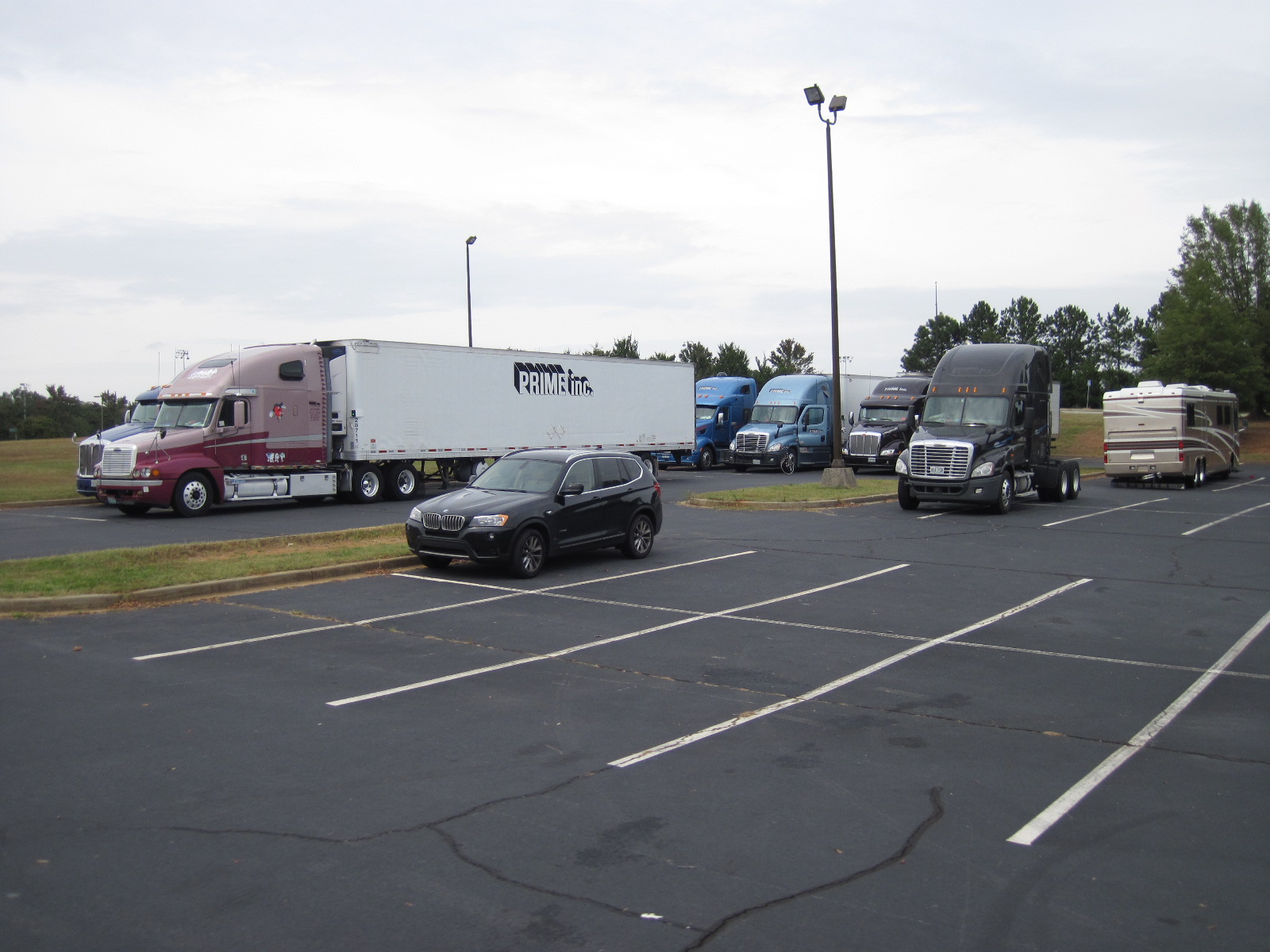
Cindy and I have been active on a Facebook group called Truckin' Runners. Most of the posts are about places to park a truck and go for a run. Topics also include running equipment, shoes, cross-training, and some tucking industry stuff. We also encourage each-other, or offer consolation, about our workouts and race plans. The group consists of everyone from people who just walked the first mile in years to runners who race Ultra-Marathons, or races longer than the 26.2 miles of a marathon. The group is very supportive. We are an unusual niche, drivers who want to make an effort to stay fit while trucking. We connect very well with each other, and are often looking for a chance to do a workout together somewhere on the road.


The Truckin' Runners had been trying to get a group together for a race for some time. The 2013 Flying Pig Race Series was the biggest turnout yet, with six members racing. The race offered a 5K, a 10K, a 10K Pump-N-Run where you bench press a weight determined by your weight and age, then run, and a marathon. I decided to run the marathon. Cindy decided to run the 5K.
I had a shorter time to train then I would have liked, but it could have been enough. I missed some runs because I was helping Cindy with her training, but I still could have had plenty of workouts. I drive a truck for a living, and do not have a regular schedule, but I have trained for other marathons successfully in the past. The three together got me this time, though. I ran far fewer total miles then past marathon training, and did not get in the critical long runs I needed.
Run another race the day before your marathon.
Cindy had used the Couch-to-5K program to work her way through the steps needed to race a 5K. I had gone on almost all of the workouts with her, and was proud of her improvements. She had run/walked a couple of 5K races before, but this was the first one where she had really put an effort into the training. I thought she could break forty minutes, but she was concerned that her time might be very slow. As the date of the races came about, I knew I was not going to have a great marathon, so I signed up to run with her. It just seemed right, after all the training we had done together. Cindy ran 39:42. I will always treasure the memory of running that race with her, and would not trade it for anything. Even a great marathon.
Have a few beers the night before the race.
What the heck, the other runners were celebrating great times in the 5K and 10K, why not tip a few with them? Well, other than dehydration, lower energy levels, and an increased inflammation response. The micro-brewery had some tasty beer, though. It was nice to visit with friends.
Leave your gear in the hotel room
OK, I always ran with my Garmin 205, and it did not make it to the race with me. I like to watch my pace, and needed to keep on track with my Garmin if I was going to keep from doing something stupid like starting off too fast.
Start off too fast.
John Weibe was the other Truckin' Runner who had signed up for the marathon. We met up in the starting corral before the race. My goal for 2013 was to run a nine-minute-per-mile marathon. That would work out to 3:55:48 total time. John had run marathons faster than that before, and was expecting to be under four hours, but not a lot under four hours. We decided to run together, at least for a while.
I had never raced with someone before. Maybe having some companionship would help me meet my goal, even though I was not really prepared. I started looking for the pacer with the banner that read 4:00. John looked for the pacer with 3:40. Eeeks. What the heck, I came to spend time with my friends. Maybe I could see how much good having a running partner could be. Maybe I could coast to a 3:40 and qualify for Boston. Maybe I'm and idiot and I would pay for my mistakes.
Do not change your race plan to meet your training.
The band at the start line stopped playing. I wonder what their manager told them about the gig. Be there at 4:00 in the morning, dress warm, and act excited. The announcer gave proper homage to the sponsors, and we had a moment of silence in memory of the victims of the bombing at the Boston Marathon earlier in the year. Then we were off. I love the start of a race. The sun was just turning the sky pink as we ran over the bridge into Kentucky.

John and I were talking, and maintaining a pace between 8:30 and 8:45 minutes per mile. After we got warmed up and the running smoothed out we crossed over the bridge back to Ohio. I noticed that my respiration did not fully recover from the "hill" the bridge created. We crossed the 5K mark. I asked John how he felt. He said he felt like he was "taking a walk in the park." I felt pretty good, but this was my fourth marathon, and I knew my breath was too short and my heart was too fast for only being at four miles. I told John I was going to slow to a 9:00 per mile pace, and I would see him at the finish line.

The huge hill starts about mile six. I watched the pace teams go by me, and tried to stay with the 4:00 team. They had gotten a bit ahead of me, but I caught them on the last half-mile of the hill. As we crested the hill, they took off, and as they rounded a corner, I knew I had seen the last of them. That was near mile eleven. If I had listened to my own common sense, I would have switched to the Half-Marathon in the week before the race. I still could have ran with John, because the races started at the same time. The runners of the half split off from the runners of the full during the race. If I knew I only had a couple more miles to go, I may have been able to finish the half strong, probably around 2:00. As it was, I went into survival mode. I had fifteen more miles to run, not two.
Set absurd, unrealistic goals.
Setting mid-run goals is something I do in my training. I like to tell myself that if I run hard to the next phone-pole, I can slow up for a while. Or that if I keep my pace for a certain amount of time, I can take a drink out of my water bottle. I have found that I need to take my reward, or my body figures out that I am trying to trick it and the goal-setting does not work.
I told myself that if I made it to mile sixteen with no walk-breaks, I could take my shirt off to stay cooler. I had been walking through the aid stations, but I meant a real walk break, like 2/10 of a mile. Or a nap. Next thing I knew I was walking up to the aid stations, and a bit after. Those stations where they hand out water and sports drink got to be a quarter-mile long. I could not make my goal, but I still took my shirt off.
I set several goals I did not complete, and it was a bit discouraging, but I did set one that did me some good. I decided to have fun. I called Cindy at mile fifteen to tell her I was going past a Kroger Grocery store. I asked her if she needed me to pick something up, maybe a gallon of milk or a case of soda. The runners around me looked at me either in horror or with a smile. At mile seventeen, there were some national guardsmen on a hill with what looked like AK-15s. It was a somber reminder that after the Boston terror attack this sight may become a part of marathons. I hollered at one of the guardsmen. "SHOOT ME!" They looked surprised, then laughed. "C,mon," I said. "Really land one, too. If you wing a runner they will just keep going." I got a few chuckles from the other runners, but no one offered to knock me out and end my pain.
Keep running.
Of course, I could have stopped at any time and had my first DNF (did not finish). By the time I met my cheering section at about mile twenty, I was really hurting. My legs were cramping, my back was going into spasms, I had gotten light-headed a few times. They had seen John go by some time ago, and he still looked strong. I did not. He ended up finishing in 3:53:40, and was happy with the time on such a hilly course. Jon Narron, who had crushed his goal of breaking an hour in the 10K the day before, ran with me a bit as a way to cheer me on.

The last three miles were brutal. I had left my shirt with Cindy back at mile twenty. Now a cold rain had begun. I no longer had the energy to enjoy all the fun pig-related signs. I was down to half-walk/half-run regiment. I set a final goal to run the last mile. I got tunnel vision, and every step my legs said STOP STOP STOP. I literally could not bear the thought of running 24 miles of a marathon and quiting, so I kept moving. Step by step I plodded on, hoping the last mile was all downhill. People kept lying to me from the sidelines "You are looking great, Daniel!" "You've got this, man!" Or the worst lie, "This is the easy part."
I went into a sort of shambling step that could be called a run at 25.2, and found that the last mile was not downhill. I did not know that a mile could be so long. I pressed on, and even picked up the pace as I entered the crowds cheering at the last few hundred yards. My wife was in the crowds somewhere, but I did not see her. I crossed the finish line. I always remember the finish line. This one hurt, but I did cross it. My time was 4:53:49, but I crossed the finish line.
The other Truckin' Runners fared better than I did. Cathy Cogswell beat her goal in the 10K, and Pete Mycek maxed out the bench press at the Pump-N-Run with 20 reps that lowered his 10K time of 45:56 to where we won his division, and medalled as the third male overall.
I like that it makes perfect sense.
I had prepared less for this marathon than any other, and I had ran my slowest time. I am encouraged that if I prepare enough, I can break 4:00 in 2014.



 I had paid $400 for
my bike. While shopping I had discovered that racing bikes cost
anywhere from $800 to $4000, and most used bikes were close to $1500. I
clicked pretty well with the cycling part of the race, and started
counting the total value of the bikes I passed. Me and my "vintage" Cannondale passed about $40,000 of fancier race and tri-bikes. About two miles from the end of the cycling part, I
finally had a mechanical challenge. The front chain came off the
gear. Reaching down, I thought I could get it back on while rolling
22 mph. After a few tries, I decided to stop and fix the chain
before I hurt someone. Especially me. Then when I stopped, I forgot
that I had on toe-clip pedals that keep your feet on the bike. I
just barely kept from crashing to the ground before finding out that
I could not lift my fatigued leg over the seat of the bike on the
first try. So much for dominating the cycle course. I looked more
like a Three Stooges routine. Chuckling at myself, I quickly got the
chain on and took off again.
I had paid $400 for
my bike. While shopping I had discovered that racing bikes cost
anywhere from $800 to $4000, and most used bikes were close to $1500. I
clicked pretty well with the cycling part of the race, and started
counting the total value of the bikes I passed. Me and my "vintage" Cannondale passed about $40,000 of fancier race and tri-bikes. About two miles from the end of the cycling part, I
finally had a mechanical challenge. The front chain came off the
gear. Reaching down, I thought I could get it back on while rolling
22 mph. After a few tries, I decided to stop and fix the chain
before I hurt someone. Especially me. Then when I stopped, I forgot
that I had on toe-clip pedals that keep your feet on the bike. I
just barely kept from crashing to the ground before finding out that
I could not lift my fatigued leg over the seat of the bike on the
first try. So much for dominating the cycle course. I looked more
like a Three Stooges routine. Chuckling at myself, I quickly got the
chain on and took off again. 


